
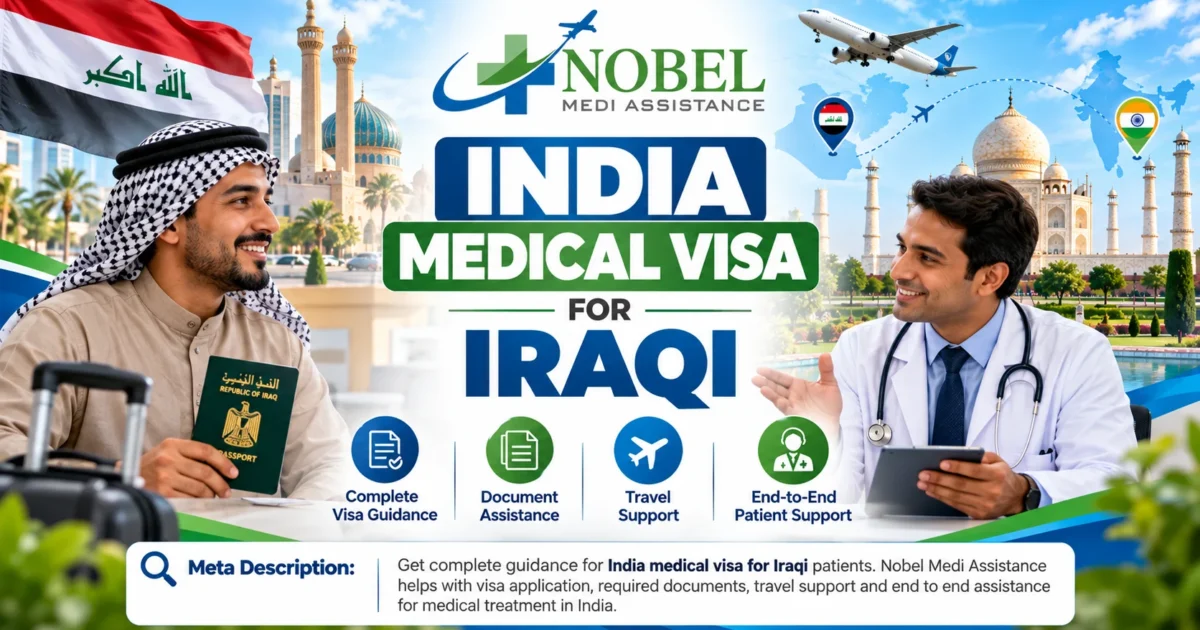
Iraqi citizens who travel to India for treatment need a medical visa. Depending on current eligibility rules, you either apply online for an e-Medical visa or submit a regular medical visa application through the Indian embassy in Baghdad, the consulate in Erbil or an authorised visa centre. Both routes need a valid passport, a hospital letter from the Indian hospital and medical reports in English. Companions apply for a separate medical attendant visa.
Iraq is one of the countries that send patients to India for heart surgery, cancer care, transplants, joint replacement, spine surgery and fertility treatment. The trip is manageable when the paperwork is right. This guide explains which visa to use, what to prepare, how to handle translations and what to check before you book flights.
Quick facts
- Visa routes: e-Medical visa (online, if your nationality is currently eligible) or regular medical visa (mission or authorised centre)
- Missions: Indian embassy in Baghdad and a consulate in Erbil, plus any authorised visa centres
- Key document: Hospital letter from the Indian hospital
- Reports: Should be in English, or come with an English translation
- Attendants: Companions need a separate medical attendant visa
- Check before you apply: Eligibility, fees, validity and entry points change, so confirm on the official Indian visa portal and your mission’s website
Which visa options do Iraqi patients have?
| e-Medical visa | Regular medical visa | |
|---|---|---|
| How you apply | Online on the official portal | At the Indian embassy, consulate or authorised visa centre |
| Who can use it | Nationals of countries on the current eligible list | Patients from any country, including those not on the e-visa list |
| Best for | Planned treatment with a clear, shorter timeline | Longer treatment, repeat visits or complex cases |
| Visit to a mission | Usually not needed before travel | Usually needed for submission or biometrics |
| Attendant | e-Medical Attendant visa | Attendant visa at the mission |
| Hospital letter | Required | Required |
Eligibility lists change, so do not assume. Check the official portal to see whether Iraq is currently eligible for the e-visa. If it is not, the regular medical visa is your route. Our e-Medical visa vs regular medical visa guide compares both options in detail, and the complete guide to the medical visa for India covers the general rules.
Which route should you choose?
Choose the e-Medical visa when:
- Iraq is on the current eligible list
- Your treatment and recovery fit within the e-visa stay period
- You can enter through a designated airport
- Your hospital letter and documents are ready
Choose the regular medical visa when:
- Iraq is not on the e-visa list
- Your treatment may be long, such as multi-phase cancer treatment, a bone marrow transplant or an organ transplant
- You expect follow-up visits
- Your case is complex and the plan may change
- You prefer to speak with the mission or visa centre about your application
If you are unsure, send your reports and nationality through our medical visa assistance page and we will help you choose.
What documents do Iraqi patients need?
For the patient
- Passport with enough validity and blank pages
- Recent photograph that meets the size and background rules
- Hospital letter from the Indian hospital naming you, the treatment and the doctor
- Medical reports: diagnosis, test results, scans and a treatment summary
- Proof of funds or payment plan, if requested
- Return ticket details, if requested
For each attendant
- Passport copy and photograph
- Proof of relationship to the patient, such as a family document
- A reference to the patient’s application
Translations
Doctors and hospitals in India work in English. If your reports are in Arabic or Kurdish, get the key documents translated into English before you send them. A clear translation of the diagnosis and treatment summary prevents delays and mistakes. Send scan images in their original digital form as well, not only the written reports. A remote second opinion from an Indian specialist also works better when the file is complete and readable.
How do you get the hospital letter?
The hospital letter confirms that an Indian hospital has accepted you for treatment. It should state your name, diagnosis, planned treatment, expected duration and the hospital’s contact details.
- Send your reports and passport details through the contact us page.
- A specialist reviews your case.
- The hospital’s international patient desk confirms the plan and issues the letter.
Our guide to the hospital invitation letter for a medical visa explains what the letter must contain. You can compare accredited hospitals on the hospitals page, such as Medanta The Medicity Gurgaon, Max Super Speciality Hospital Saket and Artemis Hospital Gurgaon.
Step-by-step process from Iraq
- Send your reports with English translations and scan images.
- Receive a treatment plan and written estimate from the hospital.
- Choose the hospital and doctor. Browse specialists on the doctors page.
- Get the hospital letter.
- Pick your visa route. Use the e-visa if Iraq is eligible, or apply through the embassy, consulate or authorised centre.
- Fill in the form exactly as your passport shows your name.
- Submit documents and pay the fee.
- Apply for attendant visas at the same time.
- Wait for approval. Do not buy non-refundable flights before then.
- Print your approval and carry it with the hospital letter and reports.
Which treatments do Iraqi patients usually seek?
Patients from Iraq commonly travel for:
- Heart care: bypass, valve replacement and angioplasty. See cardiac surgery in India and heart valve replacement surgery cost in India.
- Cancer treatment: surgery, chemotherapy and radiation. See the best hospitals for cancer treatment in India.
- Spine and joint surgery: see spine surgeries in India and joint replacement surgery in India.
- Neurosurgery: see neurosurgery in India.
- Fertility: see infertility and IVF treatment in India.
- Pediatric care: see pediatric surgery in India.
The right hospital depends on your diagnosis, not your nationality, so let your reports guide the choice.
How should you plan travel and arrival?
- Flights: Check current options from Baghdad, Erbil, Najaf and other Iraqi cities to Delhi, including connecting routes. Book flexible tickets, since discharge dates can move.
- Entry point: If you use the e-visa, enter through one of the designated airports listed on the portal.
- Arrival support: Ask your coordinator to arrange airport pickup and the first hospital visit.
- Accommodation: Many patients stay near the hospital. Ask about serviced apartments for longer stays.
- Language: Ask whether the hospital can arrange an Arabic-speaking interpreter. This matters most at consultation, consent and discharge.
- Food: Many patients prefer halal meals. Ask the hospital and your hotel what is available before you arrive.
- Medicines: Carry current medicines in original packaging with your doctor’s prescription and a written list of doses.
How should you handle payment?
Ask the hospital or your coordinator how payment works before you travel: which currency is used, when each payment is due and who receives it. Pay only into the hospital’s official account or through a clearly documented process, and keep every receipt. Plan for more than the procedure alone. Our guide to the real cost of a surgery trip to India shows how stay, food, transport and a safety buffer add up. If you are choosing a company to coordinate the trip, read how to choose a medical tourism facilitator in India first.
What mistakes should you avoid?
- Using a tourist visa for treatment. It does not cover medical stays.
- Sending reports without English translations. Doctors cannot assess what they cannot read.
- Assuming you are e-visa eligible. Check the current list first.
- Applying without the hospital letter. The application will stall.
- Choosing an e-visa for a long treatment plan. You may run out of validity.
- Name differences between the passport and the form. Copy the passport exactly.
- Booking flights too early. Wait for visa approval.
- Forgetting the attendant’s visa. The companion needs one too.
- Using copycat websites. They charge extra for the same form.
What if treatment takes longer than planned?
If your doctor advises a longer stay, speak to the hospital’s international patient desk and your coordinator about the options under your visa type. An e-visa has fixed validity and entries, so a longer plan may need a different route. Keep your reports updated so you can show why more time is needed. Our medical disclaimer explains that treatment plans can change after examination.
How does this fit into the full trip?
Visa approval is one step in a larger plan. For the whole process, read medical tourism in India in 2026 and how to plan medical treatment in India from abroad. Patients from Central Asia can read our companion guide on the medical visa from Uzbekistan and Kazakhstan. See everything we arrange on the medical services page, and read patient accounts on success stories.
Frequently asked questions
Can Iraqi citizens get an India medical visa?
Yes. Iraqi patients can apply for a medical visa, either online as an e-Medical visa if they are currently eligible, or as a regular medical visa through the Indian embassy, consulate or an authorised visa centre. Both need a hospital letter.
Where do I apply for the India medical visa in Iraq?
Through the official online portal if the e-visa is available to you, or through the Indian embassy in Baghdad, the consulate in Erbil or an authorised visa centre for the regular visa. Check your mission’s website for the current process.
Do my medical reports need to be in English?
Yes, or with an English translation. Doctors in India work in English, and clear translations speed up the review and the hospital letter.
Can my family travel with me?
Yes. Companions apply for a medical attendant visa linked to the patient’s visa. Check the current attendant limit on the official portal.
Do I need a hospital letter to apply?
Yes. The letter from the Indian hospital confirms your treatment and is a core document for both visa routes.
Is there Arabic-language support in Indian hospitals?
Many hospitals can arrange interpreters, but availability varies. Ask the hospital or your coordinator to confirm before you travel.
Plan your treatment trip from Iraq
Send your reports, with English translations, to Nobel Medi Assistance. We help match you with a hospital, arrange the hospital letter and guide you through the right visa route for you and your attendant. Contact our team to begin.